

Natural astaxanthin · A plain-English guide
The red in salmon starts in a microalga. Here is what that pigment is, and why we put 12mg in one softgel.
Most astaxanthin softgels carry 4–6mg. This page explains what astaxanthin is, where the natural kind comes from, how it differs from the synthetic kind and why it belongs in oil — without claiming it does anything it is not allowed to claim.

One softgel a day, with a meal that contains some fat. 12mg of natural astaxanthin from Haematococcus pluvialis microalgae, carried in oil.
It usually starts with a number. A figure from the NHS Health Check, a note from the optician, a blood result somebody wants to see again. You listen, you do what you are asked, and you start reading the back of everything you buy.
Then you look at the supplement aisle, and it shouts. Big promises on the front, small print on the back, and a drawer at home already full of half-finished pots that did nothing you could point to.
Here is what this page will not do. It will not tell you astaxanthin fixes, protects or supports anything. In Great Britain it holds no authorised health claim, so nobody selling it is allowed to say that — and a brand that does is worth a second look. Keep doing everything your GP has asked of you, and keep taking anything you were prescribed.
What this page will do is explain what astaxanthin is — a natural red carotenoid pigment from microalgae — where ours comes from, why it sits in oil, why we put 12mg in a softgel when most carry 4–6mg, and what we cannot tell you. That last part is the more useful half.
Which one are you?
Four kinds of people who read this page
Most readers recognise themselves in one of these four. Whichever one is you, start with your GP's advice and keep it. Everything here sits beside that.

Watching a number
“I'd like one thing in my day that I fully understand.”
You had the Health Check, you came away with a figure to watch, and you already do the sensible things your GP asked. Keep doing them, and keep taking anything you were prescribed. Nothing here replaces any of it — this is for people who like to know exactly what they add.
What astaxanthin actually is →
Glasses on the desk
“I read the small print. I always have.”
Reading glasses by the keyboard, long days at a screen, an optician you see every year. You notice detail. We make no claims about any of that — what we offer is one ingredient, one number and a straight answer.
Why 12mg, not 4mg →
Careful what you take
“If I'm adding anything, I want to know every single thing in it.”
Somebody wants to re-check a result, you are drinking more water, and you have become careful about anything new. That is sensible. Show the pouch to your GP or pharmacist before you start, and keep taking what you are prescribed.
Read what is not in it →
The label reader
“I want to know exactly what I'm putting in my body.”
The most reasonable instinct on this page, and we are not going to talk you out of it. One active ingredient, 12mg in each softgel, one softgel a day, the source named. If a label will not tell you that much, put it back on the shelf.
Read the full label →
Why this exists
We are not doctors, and this page will not pretend otherwise. It will tell you exactly what is in the pouch.
Nobody here is a doctor, and we are not going to write as if we were. We sell this for people who are tired of supplement packs whose front says a great deal and whose back says almost nothing.
So the product is deliberately simple. One active ingredient: natural astaxanthin from Haematococcus pluvialis microalgae. One amount: 12mg in each softgel. One instruction: one softgel a day, with a meal that contains some fat. Thirty softgels in a pouch, thirty days.
Astaxanthin has no authorised health claim in Great Britain, so we will not make one. What we can do is tell you what it is, where it comes from and how much you are taking — including the parts further down that work against the sale.
— The Magnavia team
The honest part
No authorised claim exists for this pigment, so here is what we can say.
Astaxanthin has no approved health claim in the UK. So instead of promises, here is exactly what is in the pouch and why it is made the way it is.
-
What the law lets anyone say about it
Astaxanthin has no authorised health claim on the GB Nutrition and Health Claims register. That means no seller may lawfully tell you it supports, protects or improves any part of your body — and we do not. What can be said is what it is, where it comes from, how much is in each softgel and how to take it. This page sticks to those four things.
No authorised claim. So we make none.
-
Why 12mg, when most softgels carry 4–6mg
Typical astaxanthin softgels carry 4–6mg, so people who choose a higher amount often take two or three a day. This one puts 12mg in a single softgel, which makes the daily habit one softgel with a meal. That is a statement about quantity, not a promise about results.
Same natural pigment. One softgel instead of three.
Read the label. Then decide.
Nothing you are doing needs to stop. This is about knowing exactly what you add.
The reframe
What a sensible routine already looks like
None of it was wasted and none of it should stop. This is about what you add to a routine, not what you replace.
-
The GP's advice
Keep following it. Whatever you were asked to do — food, walking, a prescription — carries on exactly as before. Nothing on this page is a reason to change any of it, and we would worry if it were.
Keep doing it. Nothing here replaces it.
-
More oily fish
A good habit on its own terms. A portion of salmon carries a few milligrams of astaxanthin — it is where the colour comes from — but the amount varies and you cannot read it off a fillet.
A real source. Just not a measured one.
-
The daily multivitamin
Useful for what it is. Read the back of yours: if astaxanthin appears at all, check how many milligrams. It takes ten seconds and tells you more than the front of the pack ever will.
Read the back. It takes ten seconds.
-
The 4mg softgel
Natural astaxanthin at 4–6mg is a perfectly reasonable product. It simply carries less in each softgel, so people who want more end up taking two or three a day. That is the gap this one fills.
Same pigment. Less of it in each softgel.
Nothing you are doing needs to change. This is about knowing exactly what you add.
Same red pigment. Three times the amount in a 4mg softgel.
How it works
What astaxanthin actually is
Deliberately dry. Each sentence states what something is, where it comes from or how much is in it. Nothing here is dressed up.
-
1
A carotenoid
A red-orange pigment from the same family as beta-carotene and lutein. It is what gives salmon, trout, prawns, krill and flamingos their pink-red colour. Nothing more mysterious than that.
-
2
From microalgae
Haematococcus pluvialis is a freshwater green microalga. Under strong sunlight it turns blood-red and makes astaxanthin. Ours is extracted from it as an algal oleoresin.
-
3
Natural, not synthetic
Synthetic astaxanthin is made from petrochemicals and used mostly in fish feed. This is the natural, algal kind. The label tells you which one you are buying — look for the source.
-
4
Held in oil
Astaxanthin is fat-soluble, so it is carried in oil inside a softgel and taken with a meal that has some fat in it: eggs, avocado, oily fish, yoghurt or nuts.
The statements above describe what astaxanthin is and where it comes from. Astaxanthin holds no authorised health claim in GB, and nothing here is a claim about what it will do for you.
The research
Ten things worth knowing before you buy any astaxanthin
Information only. None of it is a claim about what astaxanthin will do for you, and none of it is about any illness. Keep taking anything you are prescribed.
-
1
It is a pigment first
Astaxanthin is a red-orange carotenoid, the same family as beta-carotene and lutein. It is the colour in salmon, trout, prawns, krill and flamingos. Describing it that way is accurate and complete.
-
2
It starts in microalgae
Haematococcus pluvialis is a freshwater green microalga that turns blood-red under strong sunlight, and that red is astaxanthin. Natural astaxanthin supplements are made from it. Ours is.
-
3
Natural and synthetic are not the same thing
Synthetic astaxanthin is made from petrochemicals and is used mostly in fish feed. Natural astaxanthin comes from microalgae. The source should be named on any label — if it is not, ask.
-
4
4–6mg is typical. This is 12mg.
Most astaxanthin softgels on sale carry 4–6mg. This one carries 12mg in each softgel. We are not telling you more does more — only that this is how much is in it.
-
5
Salmon gives you a few milligrams
A portion of salmon carries a few milligrams of astaxanthin, and the amount varies from fish to fish. A softgel gives you a known amount every day, without any arithmetic.
Approximate. Amounts in food vary. Not a like-for-like comparison.
-
6
It needs fat to go with it
Astaxanthin is fat-soluble, so take it with a meal that contains some fat: eggs, avocado, oily fish, olive oil, yoghurt or nuts. Breakfast or dinner both work.
-
7
Why a softgel and not a tablet
A fat-soluble pigment sits naturally in oil, so ours is an algal oleoresin in a carrier oil, sealed in a softgel. You can see the colour through the shell — it is deep red.
Composition: algal oleoresin in a carrier oil
-
8
What is not in it matters too
GMO free, gluten free and dairy free. No proprietary blend and nothing hidden behind a combined number. The softgel shell is made from gelatin, so if you avoid animal products this is not for you.
Free-from statements as supplied with the pack
-
9
There is no authorised health claim, so we make none
This works against the sale and you should hear it from us. Astaxanthin holds no authorised health claim in Great Britain. Any page telling you what it will do for a part of your body is making a claim it may not lawfully make. We describe what it is, where it comes from and how much is in it. That is all.
-
10
Judge it as a habit
You are unlikely to feel anything in week one, and that is normal. Decide whether it fits your routine — which is why the guarantee runs sixty days rather than fourteen.
The difference
Same pigment, very different amounts
These are the ways people usually get astaxanthin. They differ in source, format and how much is in each one.
| 12mg in each softgel | Natural, from microalgae | Carried in oil, in a softgel | 12mg from one a day | More than the typical 4–6mg | |
|---|---|---|---|---|---|
| Magnavia | |||||
| A portion of salmon | – | – | – | – | – |
| A synthetic tablet | – | – | – | – | – |
| A 4–6mg synthetic softgel | – | – | – | – | |
| A 4–6mg algal softgel | – | – | – |
Ticks describe how each kind of product is typically made and how much it contains, not a comparison of outcomes. A 4mg natural softgel is a perfectly good product that simply carries less. Always read the label of anything you buy, including ours.


Pure All-Natural Astaxanthin 12mg
Pure All-Natural Astaxanthin 12mg
Pure All-Natural Astaxanthin 12mg
- From MicroalgaeHaematococcus pluvialis
- Natural Astaxanthin12mg per softgel
- Carried in Oiltake with a meal
- Free FromGMO, gluten & dairy
BUNDLE & SAVE
Couldn't load pickup availability
Free UK delivery · 5–8 business days
Order before 3pm and it ships today
- TodayOrdered
- 1–2 daysShipped
- 5–8 business daysDelivered
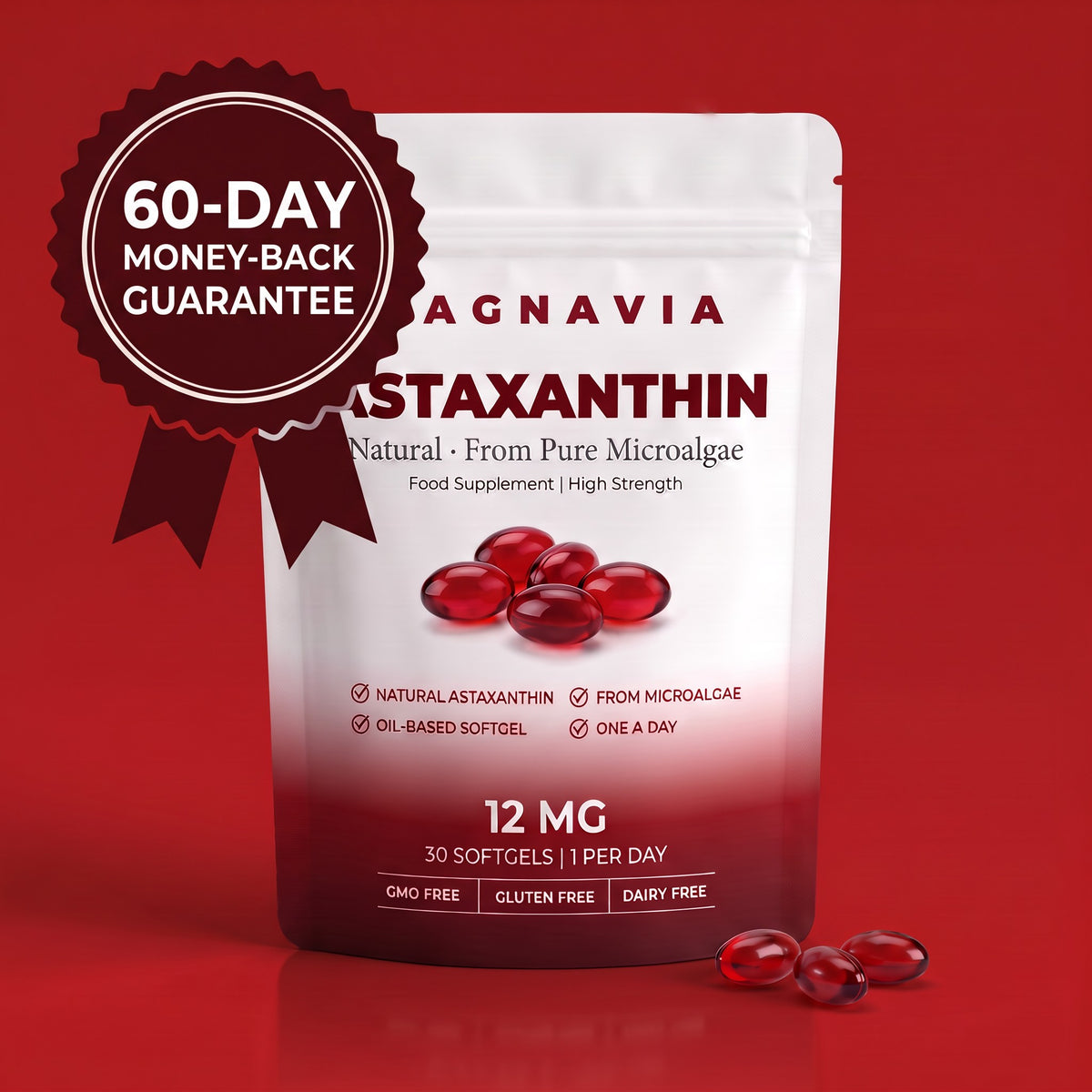
Take one softgel every day for 60 days. If you don’t think it has earned its place in your routine, email us for a full refund. No questions asked — opened pouches are fine and nothing needs posting back.
- 12mg per softgel
- GMO, gluten & dairy free
- 60-day money-back guarantee
What's inside
What's inside
Per daily serving of one softgel:
- Natural astaxanthin — 12 mg, from Haematococcus pluvialis microalgae (algal oleoresin)
One active ingredient, suspended in a carrier oil inside a gelatin softgel shell. No proprietary blend.
Free from: GMO, gluten and dairy. The softgel shell is gelatin, so it is not suitable for vegetarians.
Pack: 30 softgels in a white resealable stand-up pouch with a deep red base, a 30-day supply. Full ingredients and allergen information are printed on the pouch; please read them before use.
Food supplement. Not a substitute for a varied, balanced diet and a healthy lifestyle.
How to take it
How to take it
One softgel a day, with a meal that contains some fat. Eggs, avocado, oily fish, olive oil, yoghurt or a handful of nuts all count. Astaxanthin is fat-soluble, which is why it comes in oil. Each pouch is a 30-day supply.
Take it at the same meal each day so it becomes a habit. Three pouches is 90 days without a gap, which is why that is the pack we suggest.
Do not exceed the recommended daily dose. Food supplement. Not a substitute for a varied, balanced diet and a healthy lifestyle. Not suitable for children under 14, or if pregnant or breastfeeding. If you take medication or are under medical supervision, speak to your GP or pharmacist before use. Keep out of reach of children. Reseal the pouch after use.
Delivery and guarantee
Delivery and guarantee
Free UK delivery on every order, no minimum. Order by 3pm on a working day and your pouches arrive in 5 to 8 business days.
Shipping protection is available at checkout for £2.99, if you want it.
Email magnavia.uk@gmail.com with your order number within 60 days and we refund you in full. Opened pouches are fine and nothing needs posting back.
We set it at sixty days rather than fourteen because a daily habit deserves a fair trial. This sits on top of your statutory 14-day right to cancel under the Consumer Contracts Regulations 2013 — it does not replace it.
For people who read every label
For people who read every label
You turn the pack over before it goes in the basket. You want the amount, the source and the form in plain numbers, without a paragraph of adjectives in the way.
So here it is: 12mg of natural astaxanthin per softgel, from Haematococcus pluvialis microalgae, in an oil-based softgel. One a day, 30 to a pouch. One active ingredient, no blend, nothing hidden behind a clever name. That is the whole label.
Can I take it with my medication?
Can I take it with my medication?
We cannot advise on your individual medication, and you should be wary of any supplement company that says it can. Whether it is a statin, blood pressure tablets or anything else, speak to your GP or pharmacist before you start, and keep taking what you’re prescribed.
Take the pouch to your appointment so they can read the full label rather than take your word for it. If you notice anything unusual after starting, stop taking it and speak to your GP, and let us know too.


The terms, plainly
Sixty days to decide, and exactly how the refund works
Take one softgel every day. If after up to sixty days from delivery you do not think it has earned its place in your routine, email us at magnavia.uk@gmail.com with your order number and we refund you in full.
The small print, because you would find it anyway: one claim per customer, opened pouches are fine, and you do not need to post anything back. This sits on top of your statutory right to cancel within 14 days under the Consumer Contracts Regulations 2013 — it does not replace it.
Before you decide
The six questions everybody asks
Is natural really different from synthetic?
They are made differently, and the label will tell you which one you have. Synthetic astaxanthin is produced from petrochemicals and is used mostly in fish feed. Natural astaxanthin comes from Haematococcus pluvialis microalgae — ours is an algal oleoresin. We are not claiming one does more than the other; we are telling you which one this is.
Can I take it alongside my medication?
We cannot advise on your individual medication and we are not going to pretend otherwise. Speak to your GP or pharmacist before starting, and keep taking anything your GP prescribed — whether that is a statin, blood pressure tablets or anything else. Take the pouch with you so they can read the label. This is a food supplement, not a medicine, and never a replacement for anything on your prescription.
Could I not just eat more salmon?
You could, and oily fish is a good thing to eat. A portion of salmon carries a few milligrams of astaxanthin, and the amount varies. A softgel gives you a known 12mg every day without the arithmetic. A varied, balanced diet comes first either way — that is not modesty, it is on the label by law.
Why does this cost more than a 4mg softgel on the high street?
Two reasons, both on the label. There is three times as much astaxanthin in each softgel as a 4mg product, and it is the natural algal kind rather than synthetic. Compare milligrams per softgel and the named source, not the price on the front. The 3- and 5-pouch packs also bring the price per pouch down a long way.
How long before I notice anything?
Probably nothing you can point to in week one, and that is normal — we would rather say so now than have you disappointed at week three. This is a daily habit, not a quick fix, and we make no promise about how you will feel. Give it a fair run, which is why the guarantee lasts sixty days and the 3-pouch pack covers ninety.
Should I tell my GP?
Yes. Take the pouch with you so they can read the full label rather than take your word for it. Raise it at your next review rather than changing anything on your own. Never stop or alter a prescribed medicine without speaking to your doctor.
Being honest with you
Three things we will not do
Secondary, and worth knowing. Same rules as the rest of this page: attributed, and not a claim about what it will do for you.
-
We will not quote trial percentages
You will find impressive-looking figures quoted elsewhere for astaxanthin. It holds no authorised health claim in Great Britain, so putting any figure next to a buy button would imply a result nobody is allowed to promise. You will not see one here.
See reason nine above.
-
We will not name any condition
A food supplement that presents itself as a remedy for an illness is, in law, an unlicensed medicine. So this site talks about what astaxanthin is, where it comes from and how much is in it, and nothing else. If a supplement brand is naming illnesses at you, that is a reason to be careful, not to buy.
-
We will not promise a feeling
Nothing about the next sixty days is going to feel dramatic. One softgel a day with a meal, a pouch you stop noticing by the second week, and an honest decision at the end rather than the beginning.

One last thing
One softgel a day is the whole routine, and sixty days is a fair time to decide if it belongs.
One softgel a day, with a meal that has some fat in it. Nothing to refrigerate, nothing to measure, nothing to remember beyond breakfast or dinner.
What you are buying is a consistent 12mg of natural astaxanthin from Haematococcus pluvialis microalgae, carried in oil, thirty softgels to a pouch. The amount is on this page and on the pouch, and it is the same number in both places.
Sixty days to decide. If it has not earned its place, one email gets your money back.
Food supplement. Not a substitute for a varied, balanced diet and a healthy lifestyle. Do not exceed the recommended daily dose. Not suitable for children under 14, or if pregnant or breastfeeding. If you take medication, speak to your GP or pharmacist before use.
Food supplement. Not a substitute for a varied, balanced diet and a healthy lifestyle. Do not exceed the recommended daily dose. This product is a food supplement and is not intended to diagnose, treat, cure or prevent any disease.
Keep out of the reach of children. Not suitable for children under 14, or if pregnant or breastfeeding. If you take medication or are under medical supervision, speak to your GP or pharmacist before use. Contains a gelatin softgel shell. Never stop or change a prescribed medicine without speaking to your doctor — keep taking anything your GP prescribed.
Astaxanthin holds no authorised health claim on the GB Nutrition and Health Claims Register, so nothing on this site describes it as doing anything — only what it is, where it comes from, how much is in each softgel and how to take it. Each softgel contains 12mg of natural astaxanthin from Haematococcus pluvialis microalgae (algal oleoresin) in a carrier oil.
